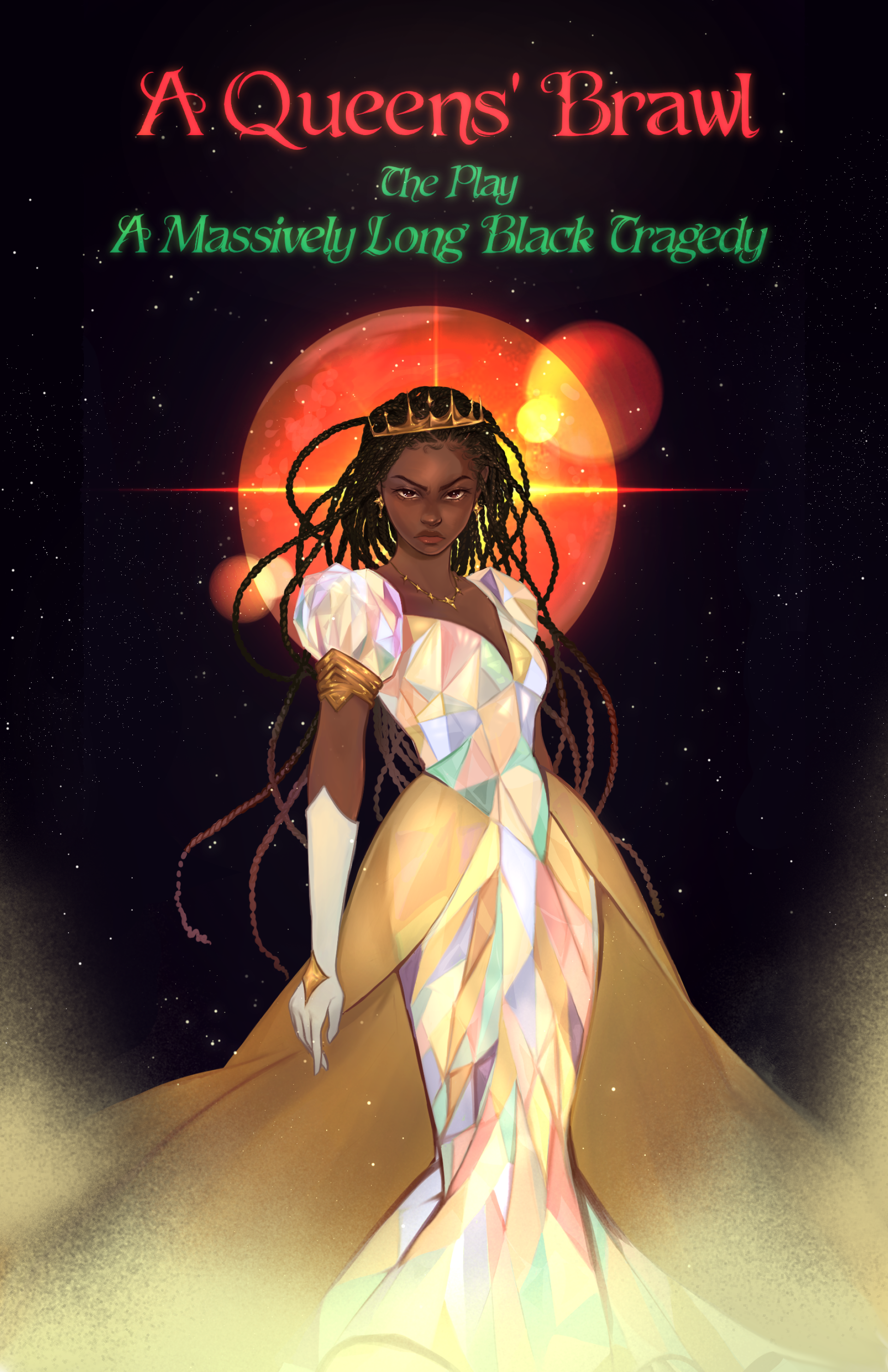
Experience A Queens’ Brawl The Play
A Massively Long Black Tragedy
The year is 2501. Seventeen years ago, Princess Kleopatra’s newborn son was stolen by those she trusted most. For years she has sharpened her grief into a weapon, gathering armies, monsters, and loyal followers for a single purpose: revenge.
“This is a brawl, one to end all brawls. A brawl on fire, and I want all the smoke I’m owed,” Queen Kleopatra
A Queens’ Brawl is a mesmerizing blend of fantasy, magic and poetic storytelling that transforms a grand dystopian world into an intensely human drama. Through unforgettable characters, it explores family, betrayal, grief, revenge, religion, diaspora war, gender expectation and racial identity. At its heart lies an enduring struggle for power and the devastating price of possessing it.
Purchase A Queens’ Brawl The Play
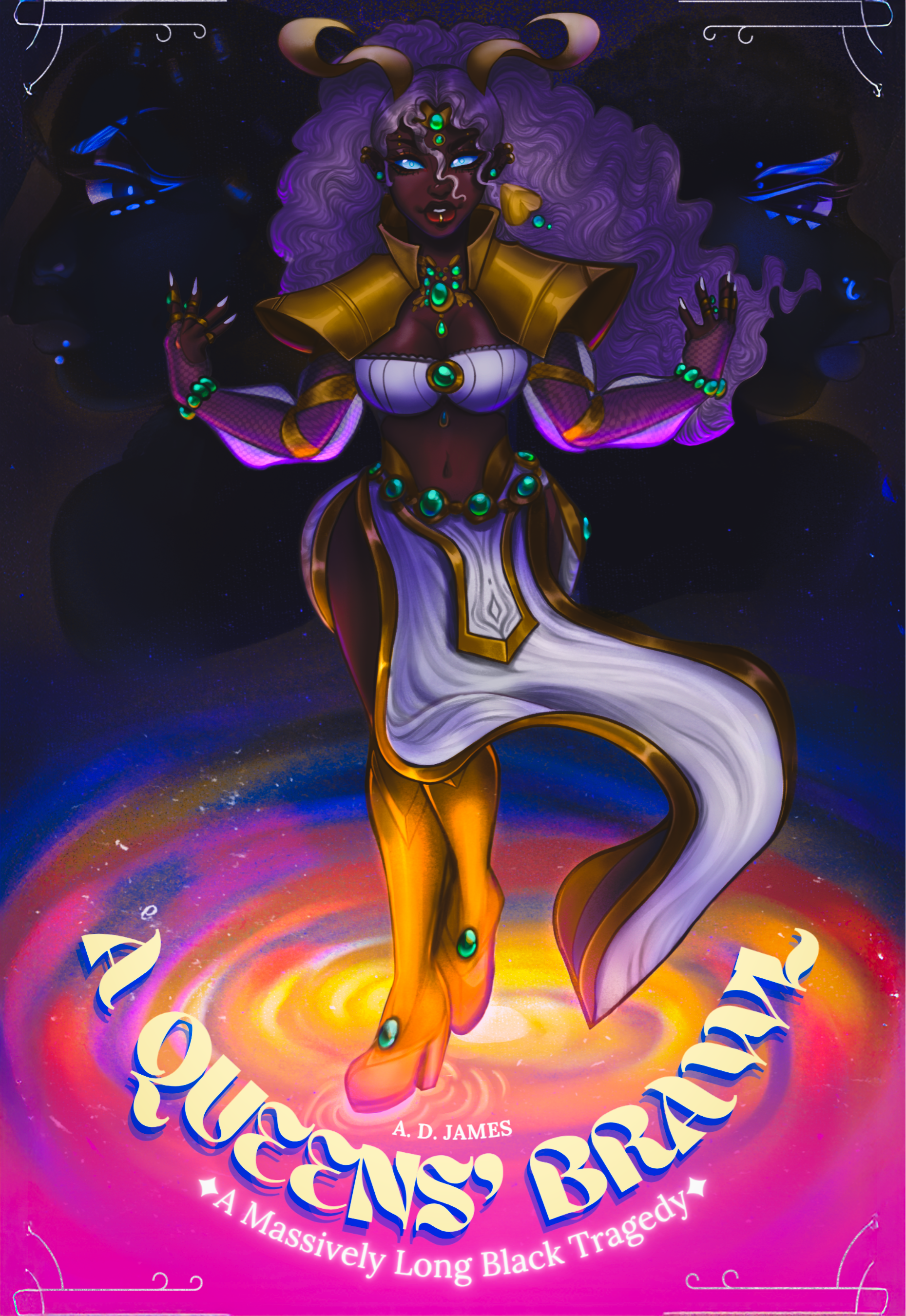
Experience the essence of a powerful and dramatic storyline with this stunning Hardcover copy of A Queens' Brawl The Play.
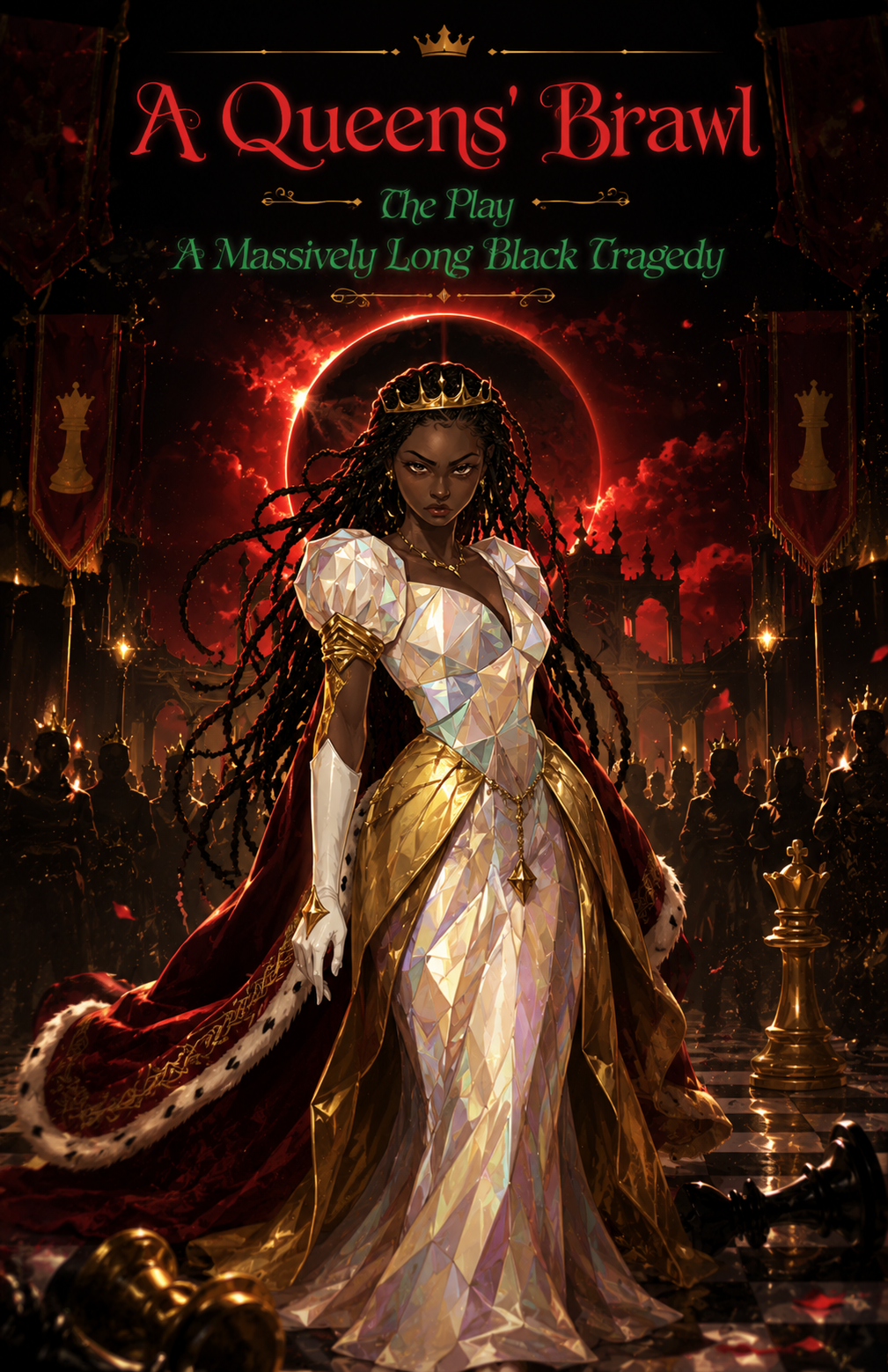
Stunning artwork inspired by the compelling play 'A Queens' Brawl'.
High-quality print in vibrant colors and intricate details.
Perfect for theater lovers, people who love dramas and people who love to read dystopian texts.
Immerse yourself in the world of A Queens' Brawl with this captivating piece that evokes the power and drama of the play's universe.
Experience the essence of a powerful and dramatic storyline with this stunning paperback copy of A Queens' Brawl The Play.
Stunning artwork inspired by the compelling play 'A Queens' Brawl'.
High-quality print in vibrant colors and intricate details.
Perfect for theater lovers, people who love dramas and people who love to read dystopian texts.
Immerse yourself in the world of A Queens' Brawl with this captivating piece that evokes the power and drama of the play's universe.
Timeline Leading Up to the Brawl
The Old World, 195 countries, seven continents, and billions of people, was destroyed in a devastating nuclear conflict known as the White War. The cataclysm ended civilization as it was known, forever transforming the planet and its inhabitants.
I
Before the conflict could claim the lives of everyone, people of the black diaspora gathered on a single island, The New World.
I
For one hundred years after the White War, the Black people of the island knew peace. The planet recovered, cities rose from the ashes, and hope flourished once more. Yet as prosperity returned, so did humanity's oldest vice, ambition. Black men, consumed by the desire to rule, fractured the land into three great kingdoms: the Highlands, the Midlands, and the Lowlands. From that division, a new era of conflict was born.
I
Despite being a monoracial continent, the people of The New World are forbidden from loving anyone beyond the borders of their own kingdom. For generations, the three realms have upheld this law, believing that unity within each kingdom is the only path to peace. Yet fate had other plans.
I
The reigning king of the north dies, leaving princess Josephine the throne. Her younger brother Leone is by her side. Her older brother Attacomea is nowhere to be found.
I
17 years prior to the brawl, Princess Kleopatra of the Lowlands fell deeply in love with Prince Leone of the Highlands. Their romance defied centuries of tradition and threatened to unravel the fragile balance between the three kingdoms. Hidden deep within The Black Forest, far from the eyes of their kingdoms, they consummated their love, binding their hearts in a union forbidden by both crowns. What they didn’t know was that a Black God had eyes on them in the forest. Kleopatra fell sick, something in the forest touched her spirit.
I
Princess Josephine, Prince Leone’s sister received a secret mission from the ancestors: kill her childhood friend, princess Kleopatra. She enlisted her brother’s help and he reluctantly agreed to murder what he thought would soon be the mother of his child.
I
Josephine and Leone tried many times to kill Kleopatra but death refused to take her. During their last attempt, Kleopatra murdered the man she once loved.
I
Meanwhile in the Midlands, Kenya is appointed queen after her husband the king dies of mysterious causes.
I
The Highlands and Lowlands engaged in a brief military conflict before reaching an agreement. Vulnerable and temporarily without power, seconds after she gave birth, Kleopatra’s father handed her newborn over to Queen Josephine as part of the north’s terms and conditions.
I
Josephine could not bring herself to kill the child, so she gave him to a loving family in the Midlands who had recently lost a child of their own.
I
Years later, King Tahir, the king of the Lowlands fell under a sleeping curse and Kleopatra became queen.
I
Desmond, a young man who was working for the queen has fled her palace with a vow of his own: the dark queen must die.
I
With Desmond on a mission to bring Queen Kleopatra to justice, she has finally declared war on both the Highlands and the Midlands, vowing to bring the sun down once and for all.
Which queendom will claim victory by the end of this brawl?
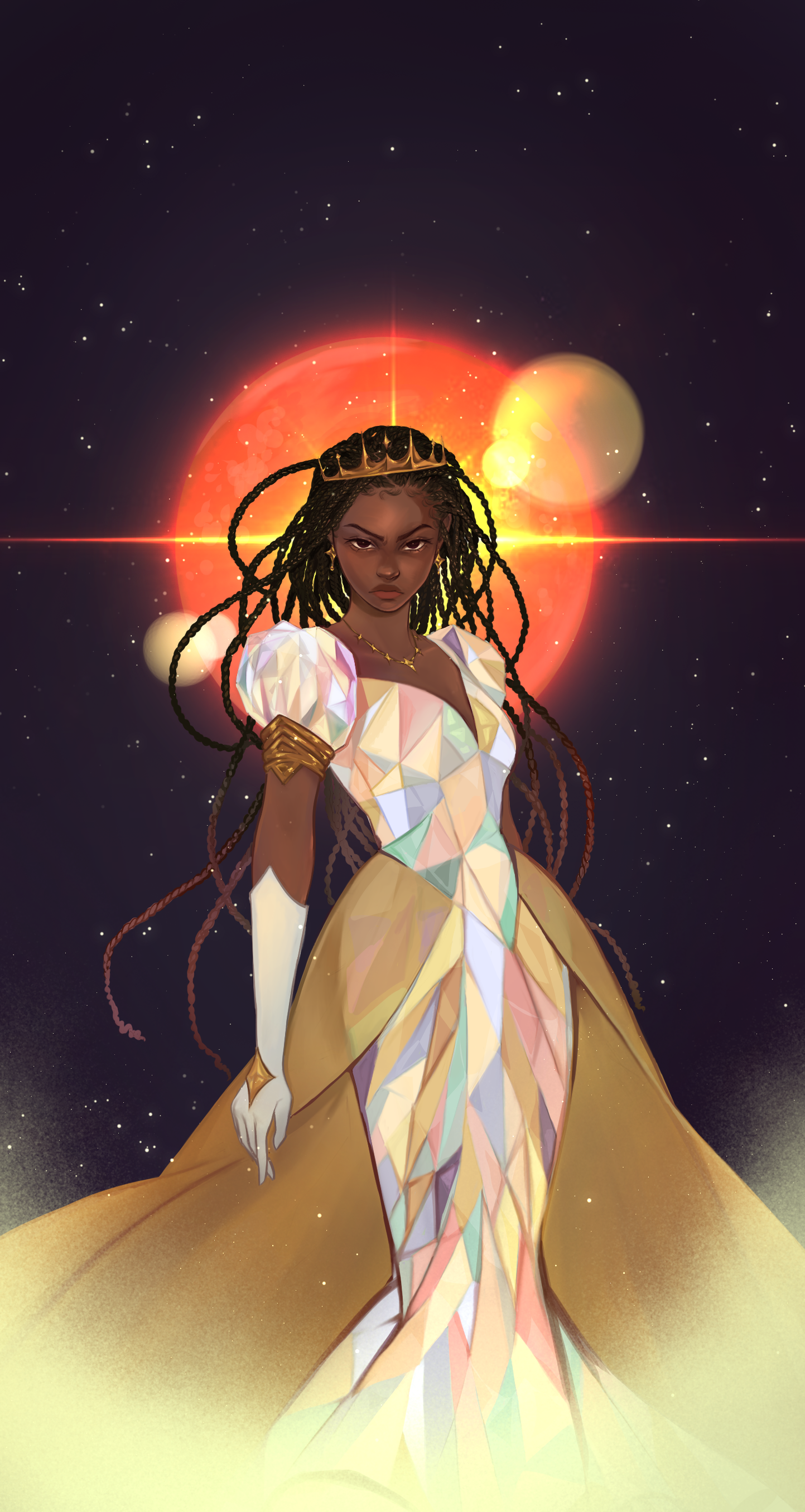
One World, Two Wars, Three Black Queens
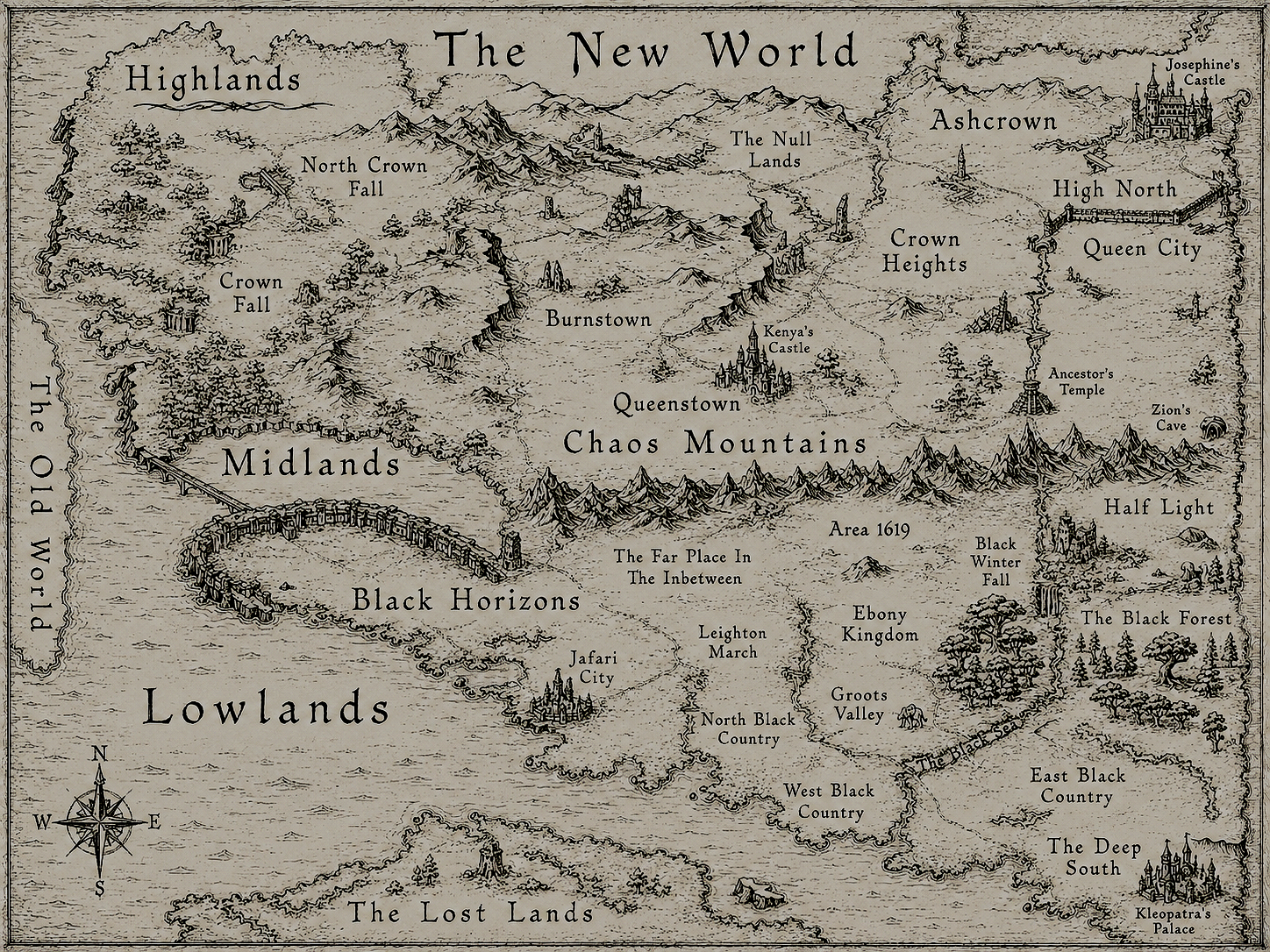
World Map
The Characters
Other Characters
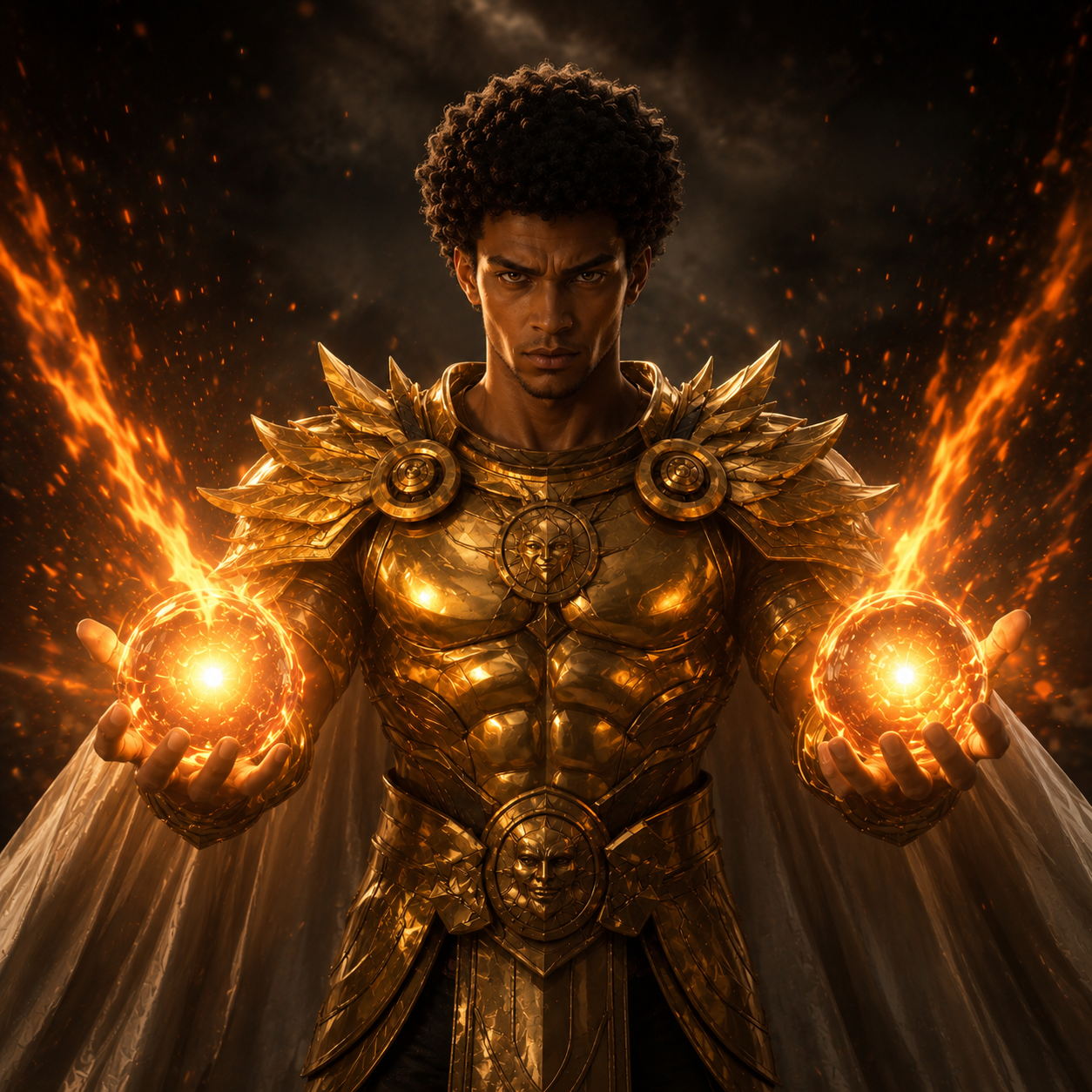
DESMOND, unknown knight/ninja
ZION, fortune teller
LORD QUAN, advisor to King Tahir
KING TAHIR, rightful king of the Southern Diaspora, father to Kleopatra, Kadeem, Kenzi and Kendrick
The Queens’ Court
LORD NIGEL , Royal advisor to Josephine
LORD RON , First advisor to the Southern Crown
GENERAL PATRICK, First General to the Southern Crown
APHIA, Royal attendant to Tashney
ISOKEN, Royal attendant to Josephine
MAKEBA, personal bodyguard to Kleopatra
THE BEAST, human cannibal, Kleopatra’s pet
VINCENT, Minister of War to Kenya, brother to Kenya
Members of the Royal Families
TASHNEY (Mistress TASH), princess of the North
LEONE (The Ancestors), dead brother to Josephine
KADEEM, brother to Kleopatra
KENZI, brother to Kleopatra
KENDRICK, brother to Kleopatra
ATTACOMEA, brother to Josephine
The Queens
JOSEPHINE, Queen of the Northern Diaspora (The Highlands)
KENYA, Queen of the Middle Empire (The Midlands)
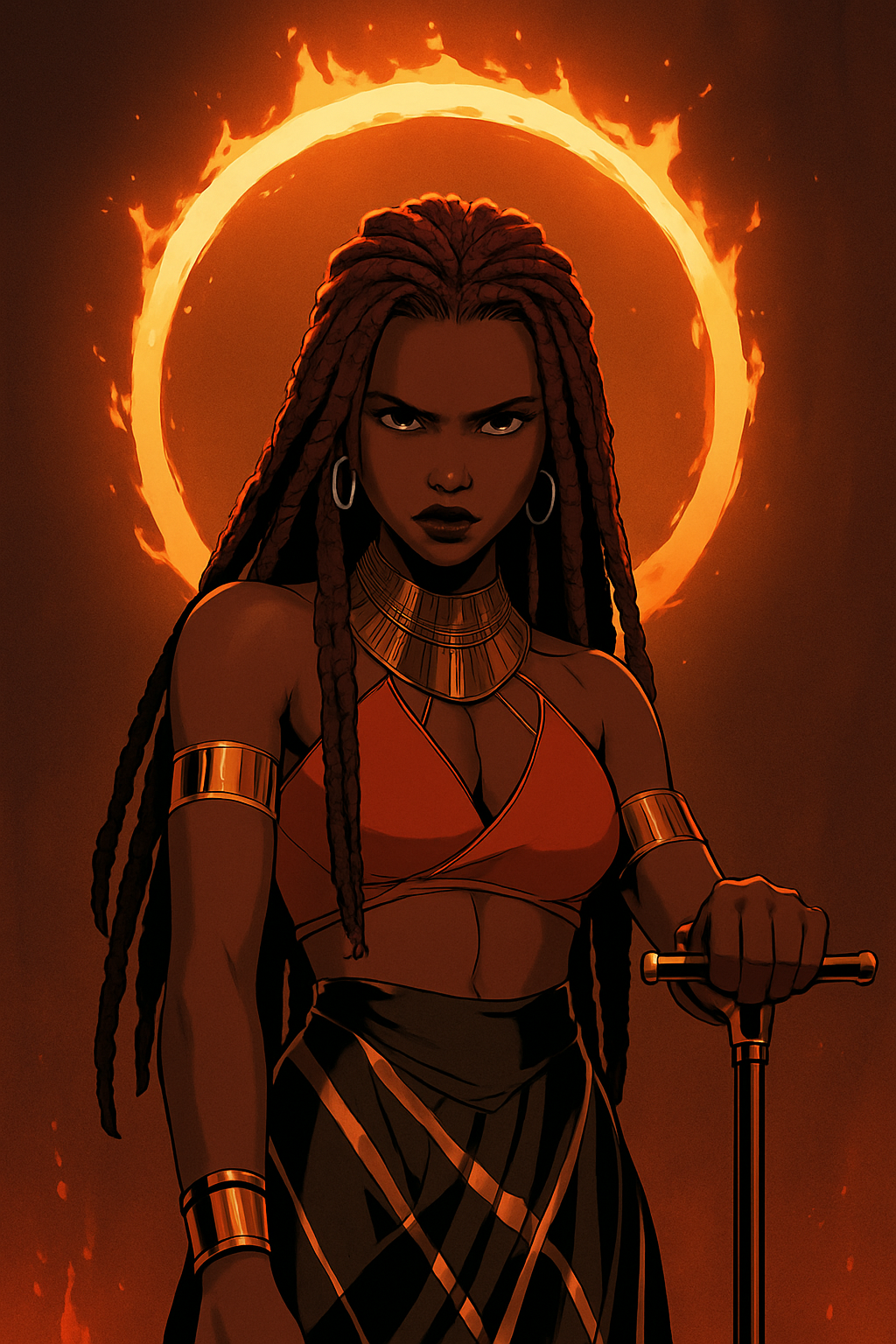
KLEOPATRA, Queen of the Southern Diaspora (The Lowlands)
Make a Donation
Want to see A Queens’ Brawl on stage?
Every act of generosity—big or small—will be spent towards a future full-length production of the play.
About The Play
A Queens' Brawl was first inspired by my mother's complex and often tumultuous relationship with her sisters. Like many siblings, they experienced moments of conflict, disagreement, and fierce rivalry, yet beneath it all remained an undeniable love and loyalty to one another. As a child, I was fascinated by these dynamics and the powerful personalities of the women in my family.
At the same time, I was drawn to stories of kings, queens, empires, and royal bloodlines. However, the rulers I saw on television and in popular media rarely looked like the women I knew. I wanted to create a universe where black people, particularly black women, could occupy positions of unquestioned power, influence, and royalty.
I realized early on that I might never witness black kings and queens ruling vast kingdoms in my lifetime, so I reached into the future and imagined a world where such figures could exist. The futuristic setting of A Queens' Brawl serves as a vehicle for establishing these characters, their authority, and the society they have built. Yet their stories are not confined to the future. My intention has always been to explore these characters across multiple periods and settings, including the present day.
Beyond its epic scope, A Queens' Brawl examines themes of family, betrayal, grief, revenge, religion, diaspora conflicts, gender expectations, and racial stereotypes. At its heart, however, it is a story about power, who possesses it, who seeks it, and the personal costs of holding onto it.
How to Teach A Queens’ Brawl
Grade Level: 11th–12th (easily adaptable for 10th)
Unit Length: 5-16 weeks (15 class periods, ~50 minutes each)
Core Focus:
Drama as literature
Race, Power, Gender, Conflict, and Voice
Close reading, performance and analytical writing
Culminating Assessment: Literary analysis essay + performance-based task
UNIT PLAN: A Queens’ Brawl by A.D. James
Unit Title: Exploring
Race, Power, Conflict, and Identity in Contemporary Drama
Essential Questions
How does conflict reveal character and power?
How does the play explore internalized oppression or conflict within the Black community?
In what ways do language and structure shape meaning in drama?
How does A Queen’s Brawl challenge traditional representations of authority and gender?
How does performance affect interpretation of a text?
Enduring Understandings
Dramatic texts are meant to be experienced, not just read.
Power struggles often reflect broader social tensions.
Dialogue, stage directions, and silence are as meaningful as plot.
Performance choices influence audience understanding.
Language as a means of persuasion
Standards Alignment (Common Core–Friendly)
RL.11–12.1 – Cite strong textual evidence
RL.11–12.3 – Analyze impact of character interactions
RL.11–12.4 – Analyze word choice and tone
RL.11–12.5 – Analyze dramatic structure
SL.11–12.1 – Collaborative discussions
W.11–12.2 – Analytical writing
SUMMATIVE ASSESSMENTS
Literary Analysis Essay (Formal)
Prompt example:
How does A.D. James use conflict and dialogue to explore power dynamics in A Queen’s Brawl?
Performance & Reflection
Small-group staged reading or scene reinterpretation
Written reflection on interpretive choices
Lesson Flow
Lessons 1-2: Introduction to the Play & Context
Objective: Students will understand drama conventions and begin exploring themes.
Activities
Bell Ringer:
What makes a “queen”? Power, title, behavior, or perception?
Mini-lesson: Elements of drama (dialogue, stage directions, conflict)
Brief author/context introduction
First cold read (teacher-led or volunteer reading)
Exit Ticket: One prediction about central conflict
Lessons 3-4: Conflict & Character Power
Objective: Analyze how conflict is introduced. Analyze characterization.
Activities
Read Act 1 (Scene 1 and Scene 2)
Group discussion: Who holds power? How do we know?
Annotate lines that show dominance, resistance, or tension
Homework: Finish reading assigned sections
Lessons 5-6: Close Reading of Dialogue
Objective: Examine word choice and tone.
Activities
Reflect on Scenes 1 and 2. What does Kleopatra want to bring about the end of the world? What secrets have Queen Josephine been hiding and why?
Small-group close reading of selected exchanges
Analyze:
Diction
Interruptions
Silence or pauses
Share findings
Exit Ticket: Why is there about to be a war? Who is to blame for the impending war and why?
Homework: Close read Act 1 Scenes 3 and 4
Lessons 7-8: Gender, Authority, and Voice
Objective: Connect text to broader social themes.
Activities
Socratic Seminar: Students discuss Scenes 3 and 4. What is the relationship like between Aphia and Tashney? Who is the real princess? How is love between people from the Lowlands and people from the Highlands viewed? What are Tashney’s motives?
How does the play portray female characters? How does the play develop motifs of poverty, loyalty and betrayal?
Textual evidence requirement
Introduce essay prompt options
Exit Ticket: By the end of Act 1, Scene 4, who is Kleopatra in search of and why?
Lessons 9-10: Performance as Interpretation - Solidifying Student’ Understanding - Tone and Mood
Objective: Understand how performance choices shape meaning.
Activities
Groups perform short excerpts twice: passages from Act 1, Scenes 3 and 4. What mood is created in these scenes? What is the author’s tone?
Once “as written”
Once with a different tone (anger, humor, restraint)
Class discussion on interpretation
Homework: Finish Act 1.
Lessons 11-15 Structure & Turning Points
Objective: Analyze dramatic structure.
Activities
Read Act 2 All Scenes - Solidify Student’ Understanding - By the end of Act 2 it is clear that this isn’t a war between territories, but a war between two black women. What are “Black Gods” and what role have they played in this impending war between Kleopatra and Josephine? Plot Desmond’s characterization. Understand that Desmond is the son that was stolen from Kleopatra many, many years ago. Address parallels between black women losing their children during every time period in history. Analyze historical allusions. Analyze Kadeem’s motives. Analyze various conflicts, - with attention to why and how Kleopatra is brining down the sun.
Guiding Questions - How does Desmond feel after finding out who Kleopatra really is? By the end of Act 2, many characters have already met their end, are their deaths justified? Are Kleopatra’s actions justified after learning that the people she trusted most betrayed her? Who suffers during times of war? In a world exclusively of people from the black diaspora, why isn’t’ there peace? Analyze why Act 1 is filled with poetry, but Act 2 is not.
Plot diagram of the play
Identify climax and turning point
Discussion: Why is the “brawl” significant?
Lessons 16-17 Imagery, Symbolism & Motifs
Objective: Identify recurring ideas or images.
Activities
Small groups track motifs (power, language, physical space)
Create visual motif maps
Lessons 18-20
Thesis Development Workshop
Objective: Develop strong analytical claims.
Activities
Model strong vs. weak thesis statements
Students draft thesis statements
Peer feedback
Evidence & Commentary
Objective: Strengthen paragraph development.
Activities
Model embedding quotations
Practice writing one body paragraph
Teacher conferencing
Performance Planning
Objective: Prepare for performance assessment.
Activities
Groups select scenes
Assign roles (actors, director, dramaturg)
Rehearse with focus on tone and movement
Homework: Read and Finish Act 3
Summative Assessment: Thematic Essay
Guiding Questions: Kleopatra’s powers seem endless, like there is nothing she cannot do. Why would she choose to take her own life? Considering Josephine’s final words to Kleopatra, was it an apology and do you feel the two queens made amends before Josephine decided to take her own life?
End of The Play Reflection Questions by Category
In what ways does the play challenge traditional ideas of leadership, authority, and respectability?
How does conflict in the play reveal the impact of systemic oppression on personal relationships?
What does the play suggest about survival, dignity, and resistance in marginalized communities?
How does voice—who speaks, who is silenced, and how—shape power in the play?
How does A Queens’ Brawl reflect the complexities of power within Black communities?
Navigating the Black Identity
How are Black identity and community portrayed as both sources of strength and conflict?
How does the play explore internalized oppression or conflict within the Black community?
In what ways do the characters reflect generational or ideological differences within Black experiences?
How does the setting influence the characters’ understanding of themselves and each other?
What responsibilities do individuals hold toward their community in the face of struggle?
Gender, Black Womanhood and Black Power
How does A Queens’ Brawl portray Black womanhood in relation to power and vulnerability?
How are Black women expected to perform strength, and at what cost?
In what ways does the play disrupt stereotypes about Black women and authority?
How does the “queen” metaphor complicate ideas of dominance, respect, and leadership?
How do gender expectations intensify conflict in the play?
Language, Voice and Resistance
How does language function as both a weapon and a form of resistance?
How do silence, interruption, and confrontation communicate power?
How does the play reflect the importance of being heard in a society that often ignores Black voices?
What role does storytelling play in reclaiming identity and agency?
How does the play suggest that speaking up can be both dangerous and necessary?
Conflict, Justice and Injustice
How does the “brawl” symbolize larger social struggles beyond the immediate conflict?
How do systemic inequities influence the choices characters make?
In what ways does the play critique systems that pit marginalized people against one another?
How does the play complicate the idea of justice—who receives it and who does not?
What does the play suggest about accountability within oppressed communities?
Student Discussion Starters
Where do you see pressure placed on Black characters to “be strong”?
Who holds power, and who appears to hold power?
When does conflict feel personal—and when does it feel systemic?